 feint labs
Can you tempt Stockfish?
Feint picks moves partly by guessing what the other person is going to play next. If leaving a knight or pawn open sets up a trap, and our player model thinks a human player is likely to grab it anyway, Feint plays the move. You can read how that scoring works in our post on move selection.
That style works on people. Someone playing online might get impatient, miss a bishop sitting across the board, or rush with ten seconds left. Stockfish has none of those habits. You can't hurry it on the clock, and leaving a free pawn out in the open isn't going to fool it.
We matched Feint (Club level, 100% Trickiness) against Stockfish Lite at a few ratings to see what happened. Mostly Stockfish shut the traps down, except in a handful of games.
The bait on e4
Look at this game between Feint (White) and Stockfish set to 1320 Elo. The opening was an Italian Game, and White has just played 30. Rad1.
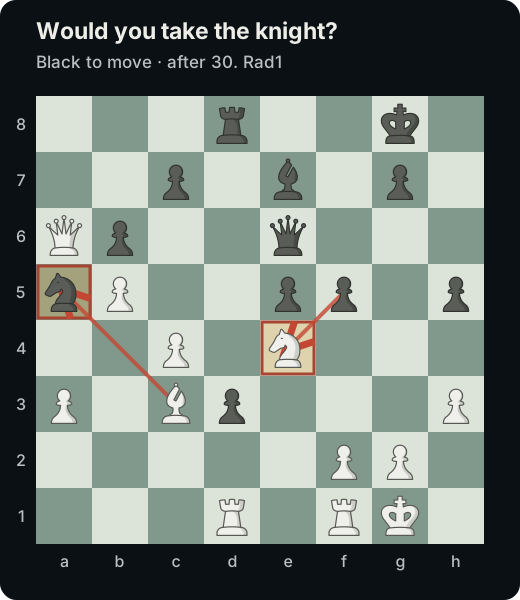
Black's f-pawn is attacking White's knight on e4. Instead of moving that knight out of danger, White just brought the rook from a1 over to d1.
To a club player, taking the knight with 30...fxe4 looks hard to pass up. Our Chessformer model thought humans would play 30...fxe4 about 68% of the time.
There is a problem for Black on the other side of the board. Black's knight on a5 has nothing defending it. Once Black takes on e4, the diagonal opens up from White's bishop on c3 straight to that knight on a5. The safer move for Black was 30...Nc4 to move the knight out of the line of fire, though our model gave 30...Nc4 only an 18% chance from a person.
So what did Stockfish do?
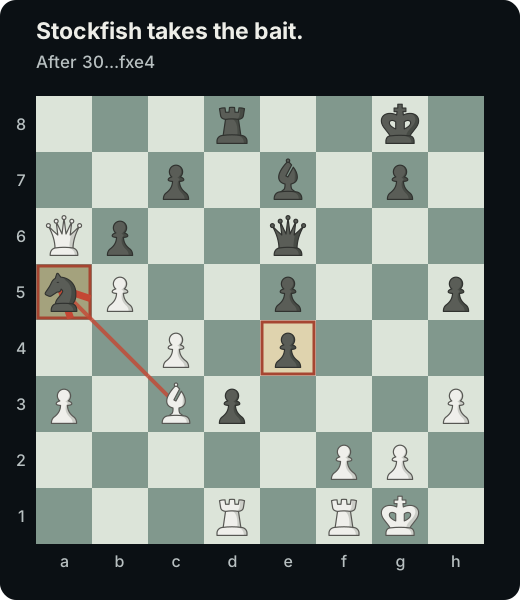
It took the knight. At 1320 Elo, Stockfish only looks a few moves ahead, so it missed the same bishop threat that trips up club players. It saw an unguarded knight on e4 and took it.
On the next move, White played 31. Bxa5 and won that loose knight on the edge of the board.
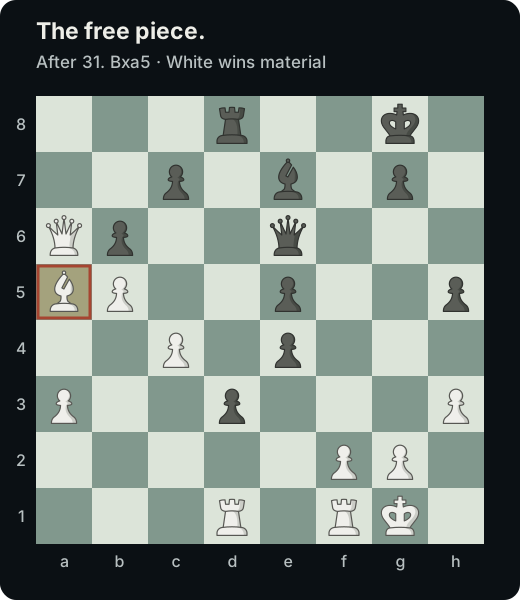
With the knight back and control of the queenside, White won the game in 95 half-moves. You can download the full PGN to play through the rest of the moves.
When Stockfish says no
Stockfish did not make a habit of getting trapped. Across 86 bait moves in our test games, it fell for 8 of them, or 9.3%.
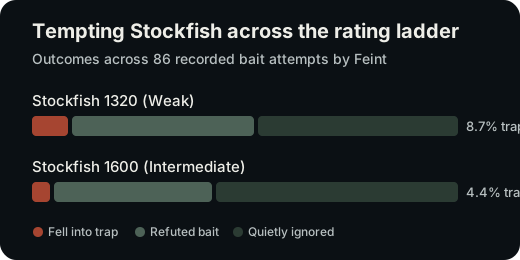
At 1320 Elo, 8.7% of the traps worked. That dropped to 4.4% at 1600 Elo, and at 2200 none of them worked.
The other 78 times (about 91% of the total), Stockfish stayed safe in two ways. Thirty-nine times (45.3%), it spotted a flaw in Feint's move and hit right back. In one 1600 game, Feint played Nb7 hoping Black would push the pawn to queen with c8=Q, and Stockfish checked with Nf5+ instead.
Another 39 times (also 45.3%), Stockfish chose safe defensive moves that club players rarely play. During another 1600 game, Feint moved a rook to e2 expecting Rf8. Stockfish moved its queen back to Qe8, a move our model rated at 0.0%. Most people wouldn't even think about putting the queen on e8, yet it stopped White's plan completely.
Built for people, not engines
Feint was built to play against people, so its traps count on human habits like taking a free knight or forgetting about a bishop across the board.
At 1320 Elo, Stockfish's short search happens to make a few of those same misses. Give the engine a higher rating, and it sees past them right away. That shows why testing against an engine feels so different from playing a human opponent.