 feint labs
What makes a computer opponent fun?
A good computer opponent should challenge you and make you want another game. We’re interested in the choices along the way: making a plan, deciding whether a risk is worth taking, or seeing through a trap.
At Feint Labs, we combine engine analysis with predictions of human play. The opponent uses both to choose its moves. It won’t always guess right.
Beyond Difficulty Settings
A useful strength setting gives you enough of a challenge to have to think, and enough of a chance to make the effort feel worthwhile.
But the games you remember often have a particular moment in them. An opening you haven't seen before. A capture that looks a little too generous. A plan you spot just before walking into it.
Against another person, you keep guessing what they'll do next. They're doing the same to you. Sometimes both players are confidently preparing for a game that the other has no intention of playing.
We want to bring more of that back-and-forth into computer games. Could an opponent choose moves partly because of the choices they give you?
Setting traps and taking bait
The basic Feint idea starts with two questions: how good is this move, and what might you play in reply?
Suppose there are two decent moves. One leads to a quiet position. The other leaves a tempting capture on the board, with a catch a few moves later. If the computer thinks you might take the bait, that second move is worth playing once it checks the cost of getting caught.
A prediction gives the computer a plan to play for, and a way to be wrong.
You know the deal going in: this opponent may try to tempt you. Any free piece is worth a second look. Spotting the trick is part of the fun, and so is finding a move the computer didn't expect.
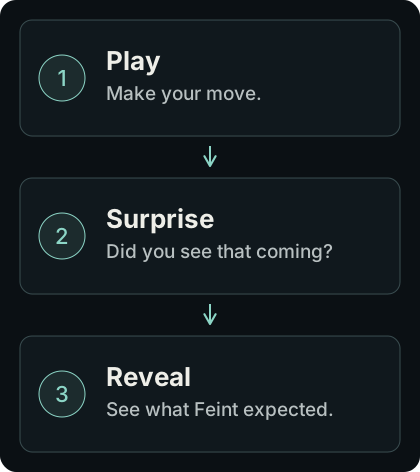
The Reveal: Seeing What the AI Expected
After the game comes the Reveal, where you can look back at the moves, analysis, and any predictions recorded during play.
Maybe the computer expected you to grab a piece, and you did. Or maybe you ignored it and spoiled the whole plan, or played a reply that never crossed its mind.
A prediction does not know why you played a move, whether you spotted the threat, took a risk, or missed it completely. You know your side of the story; the Reveal shows the computer's.
If you saw through its plan and won, that's worth looking back at too. You can check every guess the computer made, including the ones it got completely wrong.
What You Can Play Now (and What’s Next)
Feint Chess, Feint Checkers and Feint Othello are now playable in the browser. Chess is our main project and will get most of the attention here. The other boards give us different ways to test the same question: what makes an opponent worth another game?
In Chess, you can face Feint, play a more conventional opponent in Standard, or try an opponent conditioned on games from a different period in Eras. Putting a historical date on a bot doesn't mean it actually plays like the period, which makes it a good test case.
We're still finding out what makes this enjoyable. A clever idea can produce a dull game. An unexpected move can be fun, confusing, or just annoying. We'll need people playing the games and telling us which is which.
That's what this blog is for: games worth sharing, experiments that worked or didn't, bugs, and things players notice that we missed.
We're still experimenting, so the machinery described in the next post may well be replaced in the future. We'll explain what we're trying and why, including the ideas we end up dropping.
Beyond our own boards, Feint Labs builds custom game editions and takes on game-AI research. We share how our systems work under the hood so you can see whether our approach fits something you're building.
Try a game, then open the Reveal and compare its guesses with your moves. If the computer badly misjudged you, we'd like to hear about that too.